WHD 2013

Monday, August 12, 2013


Growing resilience through community gardens in Gambia


By Katie Robinson, Canadian Red Cross Society


For the first time in 15 years, communities in Gambia found themselves without food and income following poor rainfall during the 2011–2012 harvest season. Families were forced to sell their assets and livestock, or survive on charity and foraging.
 
The Gambia Red Cross Society – with assistance from the International Federation of Red Cross and Red Crescent Societies (IFRC) and the Canadian government – aimed to provide immediate and long-term assistance to vulnerable communities in the North Bank Division and Lower River Region.
 
Using a two-pronged approach, the Red Cross provided emergency life-saving interventions whilst also focusing on longer-term community resilience. Distributions of food, quality rice seeds and fertilizer addressed the immediate needs, whilst the longer-term resilience activities concentrated on women-run vegetable gardens. The Red Cross provided these gardens with infrastructure support, training, drought-resilient seeds, proper fencing and new concrete-lined hand-driven wells.
 
“Before the Red Cross came to support us, we were struggling to feed our families,” says Funneh Touray, who works in the Sukuta Women’s Community Garden in the Lower River Region. “Thanks to their support we are now able to grow our own food, and are no longer facing hardship.”
 
The community gardens are not only thriving, they are generating an income as crops and products like jams and juices are sold to nearby communities. This has allowed parents to send their children to school and pay for health care.
 
Touray is very proud of her community and is looking forward to expanding their garden. They currently have two hectares of fencing around the garden, but only half is currently being used. She is looking forward to the day when more seeds will be planted and there will be more crops to look after.
 
“I have seen a change in my community and I am very happy,” says Touray. “Many organizations have entered my village, but we have never received assistance like we did from the Red Cross. What the Red Cross has done, nobody will forget. We will maintain this garden and continue to work hard to make everyone who supported us proud.”
 
For more go to www.ifrc.org
 

Tuesday, August 6, 2013

The community-led sanitation revolution in Nigeria


By Shantha Bloemen, UNICEF


BENUE STATE, Nigeria, 5 August 2013 – Women and men, just in from the fields with hoes still in their hands, and barefoot children sit in the shade under a tree. Betty Torkwase Ikyaator asks them to make her a picture of their village in a layer of sand on the ground. With pebbles and coloured paper, they place their homes, the church, the rivers, the roads and other landmarks. They don’t mark a clinic, market or primary school because they don’t have those things here in Mbanumbekem village in rural Nigeria.
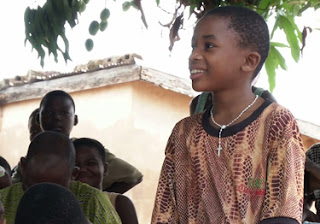
 
 
The sessions that teams like Betty Torkwase Ikyaator's run use
shame, humour and enlightenment to trigger clarity among
individuals on how sanitation links to well-being and to encourage
them to decide to act collectively in making a change© UNICEF
Ms. Torkwase Ikyaator asks about their toilets. A debate erupts over just how many the community of 45 households has among them. They settle on eight. Then, a member of the eight-member water, sanitation and hygiene (WASH) team from the local government authority (LGA) brings out a plate of food and asks the group if it looks tasty. Everyone agrees that the food, indeed, looks delicious.
 
The Assistant Hygiene Promotion Officer from the LGA team offers a community member a sample. Then he places the plate next to a pitcher of water and a small pile of, well, human excrement that was collected from nearby. It does not take long for the flies to start swarming, moving from the pile to the plate and back again.
 
He generously offers all the villagers a chance to sample the food. They giggle, but refuse. He offers them water from the pitcher. They giggle and refuse again. The point is made.
 

A commitment to toilets

 
Another member of the team asks some children to walk her through the village. She asks them to show her where they use the toilet. They lead her to a leafy area, near mud brick homes and a communal toilet that appears seldom used. The children point to the open area, which is enveloped by a strong stench. The children laugh, while chickens and goats amble among them, mixing their excreta with the human deposits.
 
Back with their parents, the children report where they have gone. The community leader reinforces the concern that something must be done about where all the villagers defecate. A lively discussion follows among the villagers, heavily punctuated with several solutions.
 
A committee is formed. Its volunteers agree that, over the next month, they will work to ensure that each household builds its own toilet. A record is made of each villager’s commitment to construct and use a toilet.
 

A trigger for change

 
This situation, in UNICEF vernacular, is a ‘triggering’ moment. Ms. Torkwase Ikyaator is a water, sanitation and hygiene consultant for UNICEF Nigeria. Based in Tarka LGA of Benue State, she is one of many such people fanning out across the country to help communities realize that where they defecate is a matter of life and death.
 
Through a mix of shame, humour and enlightenment, two-hour sessions like the one Betty and her team have conducted are designed to trigger clarity among individuals on how sanitation links to their well-being and to encourage them to decide for themselves to act collectively in making a change.
 
Community-led total sanitation, as this process is known, is a globally recognized concept in use across Africa to resolve the poor sanitation and hygiene practices that contribute to the illness and death of millions of children.
 
There were 15 communities reported to be open defecation free in 2008. Community-led total sanitation has come a long way since, having transformed the lives of over three million people in what are now more than 4,500 communities reported open defecation free.
 

A way of life

 
Ms. Torkwase Ikyaator and her team have triggered more than half of the 250 communities on their to-do list. She seems happy with the commitments and promises made in Mbanumbekem. She and the team from the LGA will be back to check on progress. The process is not preoccupied with the technical aspects of the toilet, but rather seeks to ensure that every family understands its value. Improvements can always be made at a later stage, as the use of the toilet and its value become better appreciated.
 
The team travel to Mbanzua community for a return visit. This community remains committed to staying open defecation free, which Ms. Torkwase Ikyaator is heartened to hear. To be certified, they need to keep their status for at least six months. “We keep on coming back to the community,” she says. “Checking in on them, giving them encouragement and supporting the process. But once they realize the benefit, especially in keeping their children healthy, it becomes part of their way of life.” Jacob Akem, a father of three, shows off his toilet, built with mud bricks and a simple plastic water container for hand-washing. He says he and his family now spend less of their income on visits to the clinic, and his children are much healthier.
 
Ms. Torkwase Ikyaator believes the simple and participatory process of community-led total sanitation is having a huge impact on the incidence of diarrhoea, one of the primary killers of children. But with more than 45 million Nigerians still defecating in the open, according to the 2011 Multiple Indicator Survey, she knows there is still much triggering to be done.

For more go to www.unicef.org
Follow Unicef on Twitter

Thursday, August 1, 2013

l'INITIATIVE AGIR

Vers la résilience des populations,


Par Cyprien Fabre, ECHO


Nous vous proposons ci-après une présentation de M. Cyprien Fabre, Chef du Bureau ECHO pour l'Afrique de l'Ouest, au colloque international sur "l'agriculture, la sécurité alimentaire et nutritionnelle" de l'Association des Femmes de l'Afrique de l'Ouest.


Tuesday, July 30, 2013


Kitchen gardens: one step towards resilience in the Sahel?


By ACTED


In the East Batha region, in Chad, located at the heart of the Sahel and badly affected by food insecurity, ACTED is mobilised to help the most vulnerable populations. In order to give long-term solutions to food security problems, ACTED is supporting 35 villages in the set up of kitchen gardens. In each village, several vulnerable households have come together to create a cooperative.
 
Seed and tools have been distributed and are necessary to start a kitchen garden, access to water has been guaranteed and trainings have been conducted, with the support of the United States Agency for International Development (USAID/OFDA).
 

Reaping the fruits

 
Habsita lives in the village of Tchakani, where one of the kitchen gardens was developed. She is 39 years old, married and has eight children. She often finds it difficult to feed eight mouths. In 2012, Habsita had to borrow money during the lean period, when stocks were depleted and prices on the markets are high, in order to feed her family. She then had to use all the earnings from the cereal harvest to repay her debt.
 
Habsita is now part of a group of 25 people that are harvesting a plot of land of one hectare on the edge of the river Batha. The group is working hard, under the scorching sun, to grow carrots, lettuce and other vegetables that will help them cover their needs during the lean period.
 
ACTED supports 35 villages with the implementation of kitchen gardens
and the support to gardeners groups. © ACTED.
 
Habsita is very eager to continue working on the kitchen garden: “The kitchen garden changed my life and can already see the result of my efforts. I am proud to learn and to be able to produce rather than depend on others.” With her child on her back, Habsita is tirelessly working in the field. “work in the field is hard, and not many people can do it. I am hoping that we can continue to work as a cooperative.”
 
In a region where agriculture is showing very meager outputs because of severe shocks, the development of kitchen gardens is one step ahead towards resilience. By varying their food sources, households are improving their food security and nutrition situation. Step by step, communities are reinforcing their livelihoods: “At the end of this year’s work, I will be able to go through the rainy season without having to borrow money because the harvest will be good,” concludes Habsita.
 

Monday, July 29, 2013

Community-based treatment for malnutrition earns praise in northern Nigeria


By Roar Bakke Sorenson, UNICEF


More than a half million children in northern Nigeria have been treated for malnutrition with peanut paste provided by UNICEF. Now villagers refer to the old Hausa kings of West Africa when speaking of the well-being of children, calling them the ‘Children of the King’.
 
KIYAWE, Nigeria, 23 July 2013 – Nigeria’s rates of childhood stunting and wasting are among the highest in the world, particularly in the north, where the country reaches into the Sahel region. In many cases these conditions can be life threatening if not treated properly.
 
In 2009, in collaboration with the Nigerian Government, UNICEF started a pilot project based on research recommending treatment of malnourished children in their home communities, rather than in far-off hospitals or health clinics, a treatment that often comes with an enormous cost for the family.
 
A baby is tested for malnutrition at the health centre. Credit: UNICEF
 
Fatima Yashia is one of the mothers who brought her child, 22-month-old Osman, to the Katanga primary health care centre for treatment. Osman is one of more than 500,000 children who have been through the programme in northern Nigeria in the last five years. Eating ready-to-use therapeutic food over a period of eight weeks, children are able to recover quickly from malnutrition.
 
The Community Management of Acute Malnutrition programme treats children at a decentralized outpatient therapeutic site. There, the mother and child are weighed, and the children are measured and checked for medical complications. Those with severe acute malnutrition are given a therapeutic peanut paste and vitamins. Mothers receive enough supplies to take home for a week and are told to return every week for the next two months.
 
UNICEF supports 495 health centres in 11 states in northern Nigeria.
 
“Even before I came here, I praised what they were doing, and now when I’m receiving, I am still grateful,” Ms. Yashia says. “Many people from the towns and villages praise this programme, and villagers call those children ‘the children of the king’ because they all look so very healthy. And even I received this for my child today, and I am happy. I want to thank God and the Government for this initiative.”
 
For more go to www.unicef.org


Thursday, July 25, 2013


When it rains in Mali, it pours


By Anouk Delafortrie, Regional  Information Officer in Dakar, ECHO


“I am worried about my parents. I’ve not spoken to them since we came here. They’re old. Travel is difficult for them so they stayed behind. My husband tells me they’re fine but I find it hard to believe. I would like to return but we have no money. My husband goes out every day to find work in town. If he finds some we eat, if he doesn’t we don’t,” says Assa with a grave expression while her daughter huddles up to her.
 
Assa shares a dilapidated room with her four children. Her husband, his second wife and their six children live in the room next door. She’s afraid to sleep after the first rains sent mud flowing down the walls. The wooden sticks that form the ceiling look dangerously bent as if they could collapse anytime. But they can’t afford to move to a safer place, they already owe two months’ rent as it is.


Funded by the EU, teams of Handicap International (HI) are on their daily round of visits in Sévaré, a garrison town on the crossroads between the country’s north and south, close to the town of Mopti. Some 40 000 Malians sought refuge here as conflict up north dislocated their lives. Sévaré itself nearly fell into the hands of non-state armed groups in January 2013 when fighters launched a bold offensive and advanced within 20 km of the town in an apparent effort to take control of its military airport. Fears of a ‘push through’ to the south were what triggered France’s military intervention on 11 January.
 
Six months later people in Sévaré seem to be going about their business except for many of the displaced families who feel stuck in a place that has shown them remarkable hospitality, yet isn’t home. With the onset of the rainy season the window of opportunity to cultivate their land in time for the harvest is slowly closing and with it comes the realisation that they may be dependent on aid for many more months to come.
 
When Assa’s family fled their village in the region of Douentza, with fighters on their heels, they didn’t take any belongings nor did they remember to bring identity papers. Their new neighbours gave them clothes, cooking utensils and a washbasin, but without papers they weren’t able to officially register as ‘internally displaced’ and are thus excluded from certain types of assistance.
 
 
The European Commission´s humanitarian aid and civil protection department (ECHO) funds Handicap International to seek out the most vulnerable families like Assa’s and connect them with services and actors in order to improve their housing situation and provide access to food assistance and health care. HI also helps individuals with physiotherapy or mental health needs. During the visit Assa mentions she has a belly ache.  This could be a consequence of the unpurified water she drinks or a psychosomatic reaction to the stresses of her new living conditions.
 
HI’s psycho-social advisor Laetitia Rancillac has hired five mobile teams, each composed of a psychologist and a social worker, to identify people with specific needs. “It is common for people who’ve lived through armed conflict to experience troubles related to loss and mourning. They’ve lost their bearings, their property, their status; some have witnessed violence which can result in post-traumatic stress disorder,” Laetitia explains.
 
When one of HI’s psycho-social duos visits Fatoumata she complains about a humming in her head, as if continuously reliving the bombardments on the armed group’s  base close to her home. Barely audible she recounts the events: “I was out at the river doing the laundry when the bombing started. Shells were flying over our heads. I saw a woman faint. After that, I couldn’t do anything for three days.” Fatoumata also recalls other events that made a profound impression on her, like when the neighbour’s boy picked up a grenade, threw it in the air and by doing so wounded his friend who, conscious of the impending danger, had started to run away.
 
She took her two children to her brother’s home in Sévaré while her husband stayed behind in Gao to take care of the house. “At first I felt a lot of anger, I felt violated. Now, I’m just sad,” she says listlessly casting her eyes down. Fatoumata’s brother seems happy with HI’s suggestion for her to join a group where she can discuss and share her feelings with people who’ve had similar experiences: “We don’t want her to go back like this. We want her to get better first.”
 
In Mopti, ECHO funds Handicap International to ensure the most vulnerable among the displaced people get the assistance they need. The organisation also provides help to people with mental health or physiotherapy needs and engages in explosive ordnance disposal.